Architecture Overview
MANA (Self-Healing CI/CD Pipeline) is a Kubernetes-native orchestration service that reacts to deployment events from a CI/CD pipeline and automatically recovers from failures by retrying the pipeline and, when that does not help, rolling the Deployment back to its last known-good version.
This page explains the design at a high level. Details are in Components and Data Flow.
Design Principles
- Event-driven. The pipeline reports deployment events by webhook. The orchestrator reacts to them; it does not poll the cluster for new Deployments.
- Stateful decisions. Whether to retry or roll back depends on history (how many times this deployment has failed and what the last good version was), so state lives in Redis.
- Verify, do not assume. A rollback is only reported as successful after Kubernetes shows all replicas ready and the application's own
/healthendpoint answers. - Auditable. Every decision and action produces a structured audit event.
- Simple, replaceable pieces. One small FastAPI service, Redis, and the Kubernetes and GitHub APIs. No custom resource definitions or operators.
High-Level Architecture
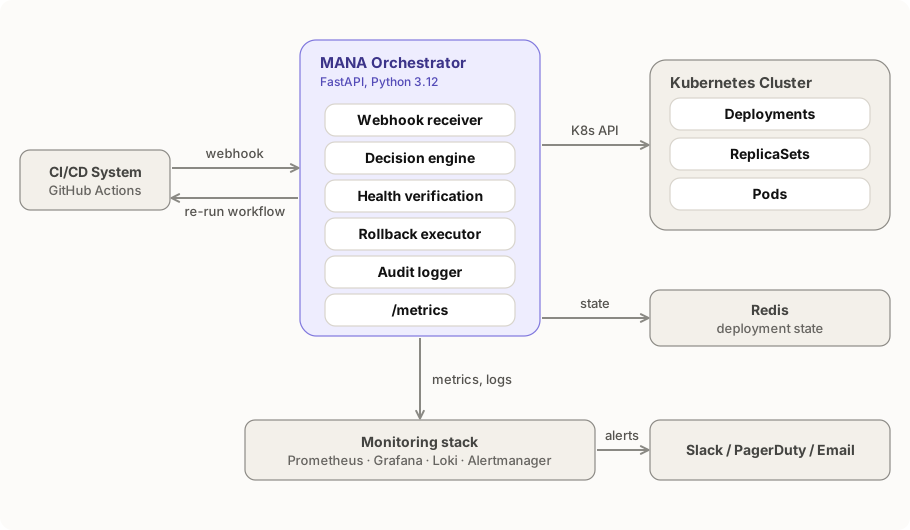
Core Components
| Component | Responsibility | Details |
|---|---|---|
| Orchestrator | Receives webhooks, decides retry, rollback or alert, executes recovery, exposes API and metrics | Components: Orchestrator |
| State store (Redis) | Deployment state (24 h TTL) and the last successful version per app | Components: State Store |
| Kubernetes integration | Reads Deployments, ReplicaSets and Pods; patches the Deployment image on rollback | uses the official Python kubernetes client |
| Health checker | Replica readiness plus an HTTP call to each pod's health endpoint | Data Flow: Health verification |
| Decision engine | Retry counting, exponential backoff, rollback rule | Data Flow: The decision rule |
| GitHub integration | Asks GitHub to re-run a failed workflow run | CI/CD Integration |
| Audit logger | One JSON audit event per action | Monitoring |
| Sample app | Flask service used as a deployment target, with failure simulation | Components: Sample Application |
| Monitoring stack | Prometheus, Grafana, Loki/Promtail, Alertmanager configuration | Monitoring |
How a Deployment Is Handled
- The pipeline deploys a new version and posts
POST /webhook/deploymentwithstatusofin_progress,successorfailed. - On success, the orchestrator records the version as the new rollback target.
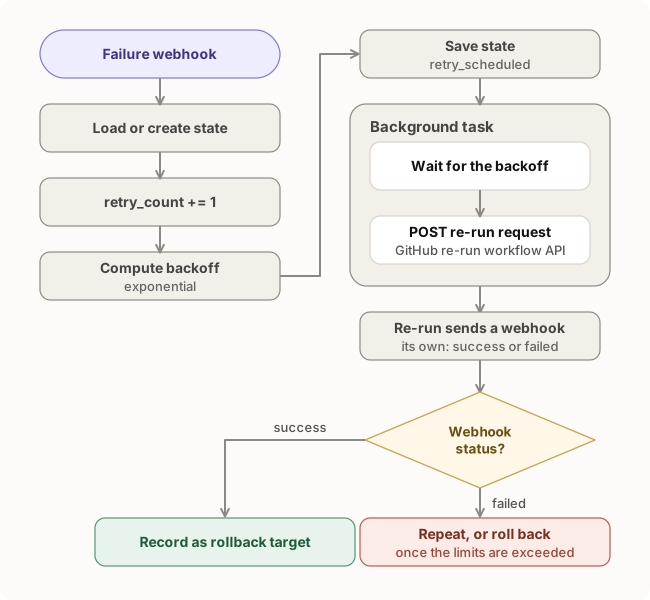
- On failure, it increments the retry count for that deployment ID and applies the rule:
- up to
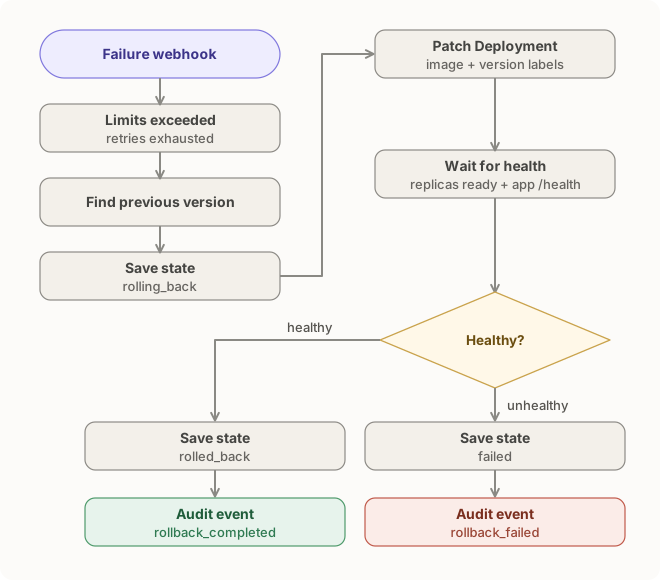
MAX_RETRIESfailures: schedule a GitHub Actions re-run after an exponential backoff; - after that, if a previous version is known and the failed version is the one running: patch the Deployment back to the last good version and verify health;
- if neither is possible (no previous version, rollback unhealthy): raise an alert (
manual_intervention_required). - Every step is written to the audit log, and Prometheus counters are updated.
The step-by-step version, with the decision table, is in Data Flow.
Retry path
Rollback path
Design Decisions
Why webhooks instead of watching the cluster? The pipeline already knows precisely when a deployment starts and how it failed, and it holds the context needed to retry (the workflow run). Watching would duplicate that and still could not re-run the pipeline.
Why re-run the pipeline for retries? A retry should repeat exactly what the pipeline did (build, push, deploy). Asking GitHub to re-run the workflow reuses all of that logic and keeps CI history accurate.
Why roll back by patching the image tag? It is explicit and auditable: the orchestrator sets the container image to the last version that reported success, rather than relying on Kubernetes revision history (kubectl rollout undo), which can point at a version that was never verified.
Why Redis? Retry counts and rollback targets need a small, fast, shared store with built-in expiry. Deployment records expire after 24 hours; rollback targets (last_successful:*) do not.
Security Architecture
The orchestrator can modify Deployments, so its permissions and exposure matter. This section summarises what the code and manifests implement today; the full model, known gaps and a hardening checklist are on the Security page.
Implemented
- RBAC: a ClusterRole limited to
get/list/watch/update/patchon Deployments and ReplicaSets,get/list/watchon Pods, andcreate/patchon Events. It cannot read Secrets. - Container hardening: non-root user (UID 1000),
allowPrivilegeEscalation: false, all Linux capabilities dropped, CPU and memory limits. - Secrets: the GitHub token comes from a Kubernetes Secret, never from an image or ConfigMap.
- Network exposure: Services are
ClusterIP; nothing is exposed outside the cluster by default. - Input validation: request bodies are validated by Pydantic models; configuration is range-checked at startup.
- Audit trail: structured events for every recovery action.
Not implemented (be aware)
- The API and webhook endpoint have no authentication; restrict access at the network layer.
- Redis has no password or TLS support in the client.
- The RBAC role is cluster-wide.
Scalability and Performance
- Replicas. The manifests run 2 orchestrator replicas that share state through Redis. There is no leader election, so if the same webhook reaches both replicas, both can act on it. Use one replica if you need strict single-actor behaviour.
- Synchronous rollback. A rollback runs inside the webhook request and waits for health verification (up to 300 s by default). Size your pipeline's HTTP timeout accordingly.
- Background retries. Retry waits run as in-memory background tasks in the replica that received the webhook.
- Listing deployments.
GET /deployments/recentscans alldeployment:*keys; it is meant for dashboards and debugging. - Footprint. The orchestrator requests 100m CPU and 256Mi memory per replica.
Failure Modes and Recovery
| Failure | Behaviour | Recovery |
|---|---|---|
| Orchestrator pod crash | Kubernetes restarts it; the other replica keeps serving. Persistent state is in Redis. Retry waits that were pending in the crashed pod's memory are lost: the state shows retry_scheduled, but no re-run is sent |
Re-run the failed workflow manually or let the pipeline send the next failure webhook |
| Redis unavailable | At startup the orchestrator exits (Cannot connect to Redis). At runtime /health reports degraded; failure webhooks fail with HTTP 500 because state cannot be saved, so no recovery action is taken |
Restore Redis. Restarting the bundled Redis loses state (it uses an emptyDir), including the last_successful:* rollback targets |
| Kubernetes API unavailable | At startup the orchestrator exits. At runtime health checks fail and rollbacks fail (the response is an alert or an HTTP 500, depending on the error) |
Restore the API server; send the failure again or call POST /rollback |
| GitHub API unavailable or token invalid | Retries are scheduled, but the re-run request fails and is logged (permission denied, timeout, or a non-201 status). Rollbacks are unaffected |
Fix the token or wait; the next failure webhook continues the process |
| Application unhealthy after rollback | State becomes failed and a manual_intervention_required audit event is written; the API returns alert |
Investigate manually; check pod logs and events |
| No previous version known | Decision is alert |
Ensure at least one successful deployment has been reported, or that pods carry a version label so the ReplicaSet fallback works |
| Duplicate webhook delivery | Processed twice (retry count increments twice) | Make the pipeline send each event once |
| Network partition | Webhooks cannot arrive, or health checks to pod IPs time out and count as failures | Heals automatically; a NetworkPolicy that blocks the orchestrator from pods or from api.github.com looks identical, so verify policies |
Technology Stack
| Layer | Technology (as pinned in the repository) |
|---|---|
| Orchestrator | Python 3.12, FastAPI 0.126, Uvicorn 0.32, Pydantic 2.9 |
| Integrations | kubernetes Python client 31, redis 5.2, requests 2.32, prometheus-client 0.24 |
| Sample app | Python 3.12, Flask 3.0, Gunicorn 21.2, prometheus-flask-exporter 0.23 |
| State | Redis 8 (redis:8-alpine) |
| Containers | Docker, non-root images based on python:3.12-slim |
| Orchestration | Kubernetes 1.23+ |
| Infrastructure as code | Terraform 1.5+, hashicorp/kubernetes ~> 2.23, hashicorp/helm ~> 2.11 |
| Monitoring | kube-prometheus-stack (chart 54.0.0), Loki stack (chart 2.9.11), Grafana, Alertmanager |
| CI/CD | GitHub Actions, GHCR, Kind for pipeline smoke tests, Snyk, Trivy, Bandit |
| Testing | pytest, pytest-cov, pytest-asyncio |
| Documentation | MkDocs with the shadcn theme |
Extending MANA
MANA has no plugin framework; extension means changing the code. The natural extension points are:
- New failure types: add a value to
FailureTypeinorchestrator/src/orchestrator.pyand send it from your pipeline. - New decision rules: edit
handle_deployment_failure(); add a test for each branch. - Other CI systems: the webhook half is CI-agnostic; implement an equivalent of
trigger_github_workflow_rerun()for your system's re-run API. - Notifications: alerts are routed by Alertmanager; add receivers in
monitoring/alertmanager/alertmanager.yml. The orchestrator itself only logsmanual_intervention_required. - Health strategies: adjust
check_application_health()for different response formats. - Other storage backends: Redis is used directly through
redis_client; replacing it means abstracting those calls.
See Contributing for conventions.
Known Limitations
Behaviours that differ from the intended design (re-run semantics, a shadowed metrics route, and some alerts without matching metrics) are listed with explanations on the Data Flow page.