Data Flow
This page traces how a deployment event travels through MANA, how the decision engine chooses between retry, rollback and alert, and what is stored along the way. For component responsibilities see Components.
Scope
Everything here describes the behaviour of the code in orchestrator/src/ and .github/workflows/. Where the implementation differs from the intended design, it is called out under Known Behaviours and Limitations.
Overview
MANA is event-driven. The orchestrator does not poll the cluster for new deployments; it reacts to webhooks that the CI/CD pipeline sends at key moments, and it consults Kubernetes and Redis only while handling an event.
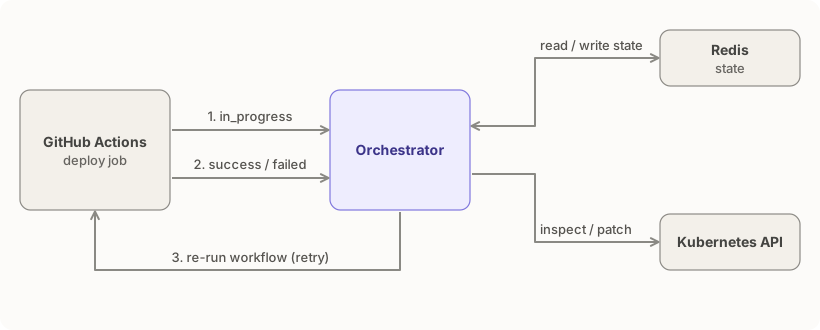
Webhook Contract
Every event is a POST /webhook/deployment with this JSON body (full schema in the API Reference):
{
  "deployment_id": "deploy-3f2a…",
  "namespace": "production",
  "app_name": "sample-app",
  "version": "v1a2b3c4-1760000000",
  "status": "in_progress | success | failed",
  "failure_type": "health_check_failure",
  "metadata": {
    "commit": "…",
    "author": "…",
    "branch": "main",
    "workflow_run_id": "123456789"
  }
}
How the orchestrator reacts depends on status:
status |
Orchestrator behaviour |
|---|---|
in_progress |
Counts the event in deployments_total and returns acknowledged. Nothing is stored |
success |
Marks the stored state (if any) as success, records version as the new last-known-good for <namespace>/<app_name>, returns success |
failed (with failure_type) |
Runs the failure-handling logic below |
| anything else | Counted and acknowledged |
Successful Deployment
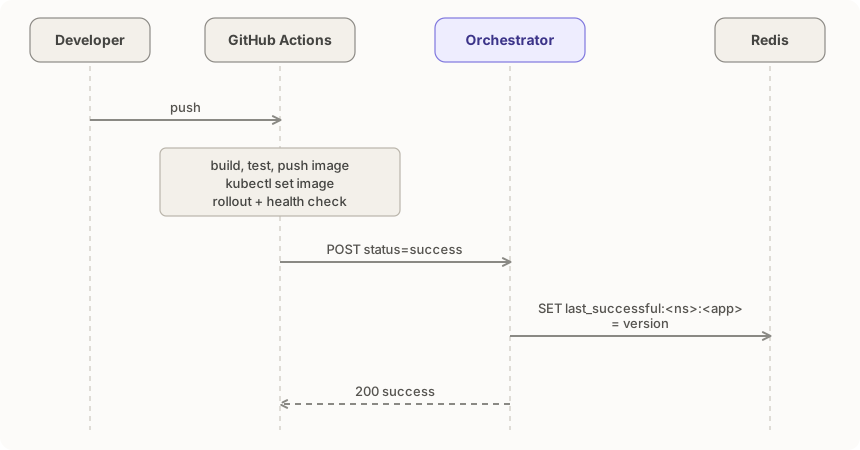
The important side effect is last_successful:<namespace>:<app_name>. That value is what a later rollback restores.
Failed Deployment
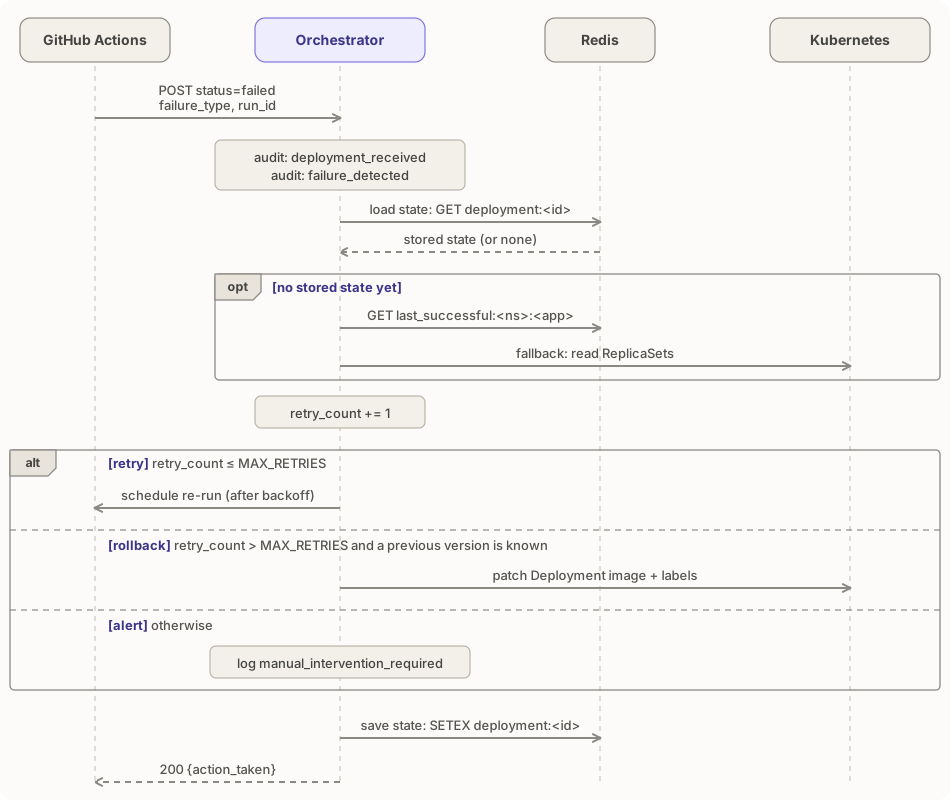
The decision rule
After incrementing retry_count, handle_deployment_failure() evaluates these conditions in order:
- Retry:
retry_count <= MAX_RETRIES - Requires
workflow_run_idin the state'smetadata, which is filled from the failure webhook's ownmetadataand from earlier state for the same deployment ID. If it is missing, the result is alert instead. - Backoff is
INITIAL_BACKOFF × BACKOFF_MULTIPLIER^(retry_count - 1), capped atMAX_BACKOFF. - Status becomes
retry_scheduled; a background task waits for the backoff, then calls the GitHub re-run API. - Alert, nothing to roll back: the failure is
build_failureortest_failure. Nothing was deployed, so rollback is never attempted for these types. - Rollback: retries are exhausted and a previous version is known and the failed version is the one running
- Before touching the cluster, the orchestrator reads the image tag the Deployment is running. If it equals the failed
version, the rollback proceeds. - If another version is running (for example the failed version never reached the cluster, or someone already rolled back), the result is skip: nothing is changed, the status becomes
failedand arollback_skippedaudit event is written. - If the live version cannot be read, or the image is pinned by digest so no tag can be compared, the result is alert.
- Status becomes
rolling_back, thenrolled_backon success orfailedif the rollback does not become healthy. - Alert: everything else (for example, no previous version is known)
- Status becomes
failedand amanual_intervention_requiredaudit event is written.
With the defaults (MAX_RETRIES=3, INITIAL_BACKOFF=10, BACKOFF_MULTIPLIER=2):
| Failure # for this deployment ID | Action | Delay |
|---|---|---|
| 1 | retry | 10 s |
| 2 | retry | 20 s |
| 3 | retry | 40 s |
| 4 | rollback (if a previous version exists) | n/a |
| 4, no previous version | alert | n/a |
Executing a rollback
rollback_deployment() performs these steps:
- Read the Deployment from Kubernetes and find the application container: the one named like the Deployment, or the only container if there is exactly one. If neither applies, the rollback fails without changing anything.
- Build the target image from the running one. The registry (including a port) and repository are preserved, the tag is replaced, and a digest is dropped.
PATCHonly that container's image and theversionlabels (Deployment and pod template). Kubernetes performs a normal rolling update back to the old image.- Check that the Deployment reports the target image after the patch. If not, the rollback fails.
- Wait for the new revision to finish rolling out (the controller observed the patched generation, every replica is updated and no old replicas remain), then for health (see below). Success writes
rollback_completedto the audit log; failure writesrollback_failedand the decision becomesalert.
Any error during these steps, not only Kubernetes API errors, counts as a failed rollback and is recorded in rollback_failed with the error type. rollback_initiated records the version that was actually running.
Previous-version resolution
get_previous_version() tries two strategies:
- Redis:
last_successful:<namespace>:<app_name>, written by the lastsuccesswebhook. - ReplicaSets: the second-newest ReplicaSet (by creation time) that carries a
versionlabel.
If both fail, the result is None and the decision is alert.
Health verification
check_deployment_health() loops (sleeping 10 s between iterations) until its timeout, which defaults to 300 seconds:
- Read the Deployment; continue unless
ready_replicas == spec.replicas. - Once all replicas are ready, call
check_application_health(): for eachRunningpod,GET http://<pod-ip>:<HEALTH_CHECK_PORT><HEALTH_CHECK_PATH>. A pod is healthy only if it returns HTTP 200 with JSON{"status": "healthy"}. The deployment passes if at least one pod is healthy. - If pods are ready but the application check fails 3 consecutive times, the check returns
Falseearly. - A Kubernetes API error returns
Falseimmediately.
Note
HEALTH_CHECK_TIMEOUT (default 5) is the per-request HTTP timeout used when calling a pod, not the overall verification timeout. The overall timeout is the 300 s default of check_deployment_health() (or the timeout field of POST /health-check).
Retry Mechanics
For a retry the orchestrator does not redeploy anything itself. It asks GitHub to re-run the failed workflow:
POST https://api.github.com/repos/<GITHUB_REPO>/actions/runs/<workflow_run_id>/rerun
Authorization: Bearer <GITHUB_TOKEN>
This happens in a background asyncio task after the backoff delay. Success is HTTP 201; 403 is logged as a missing-permission error (the token needs the actions:write permission, or the classic repo/workflow scopes). The retry endpoint does not wait for the re-run to finish. The outcome arrives later as a new webhook from the re-run pipeline.
State Model
Each deployment ID has one DeploymentState record stored as JSON under deployment:<deployment_id>:
| Field | Type | Meaning |
|---|---|---|
deployment_id |
string | Unique ID generated by the pipeline |
namespace |
string | Target namespace |
app_name |
string | Deployment name and app label |
version |
string | Version (image tag) being deployed |
status |
enum | See below |
previous_version |
string or null | Rollback target resolved when the state was first created |
retry_count |
integer | Number of failure events handled for this ID |
failure_type |
enum or null | Most recent failure type |
timestamp |
float | Unix time when the state was created |
metadata |
object | Free-form; holds workflow_run_id for retries |
TTL is 24 hours and is refreshed every time the state is saved.
Status lifecycle
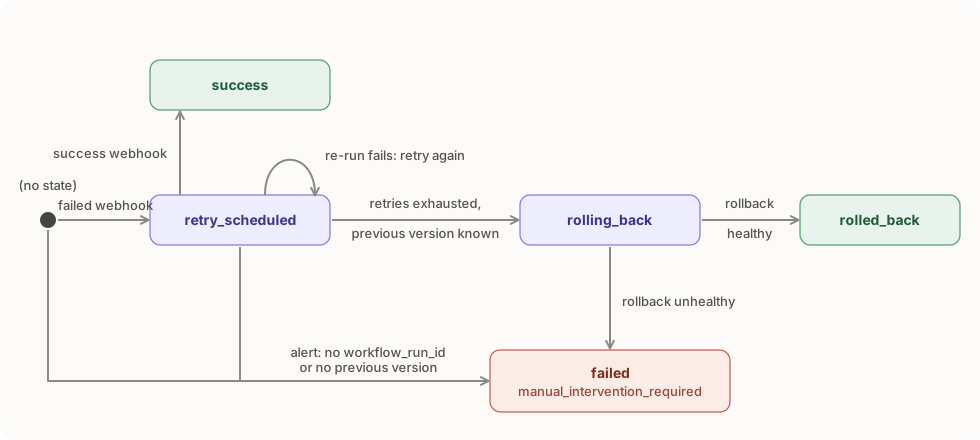
pending and in_progress exist in the enum but are not currently written by the webhook handler.
Audit Trail
Each stage above emits an audit event so the full story of a deployment can be reconstructed by filtering on deployment_id:
deployment_received → failure_detected → retry_initiated, rollback_initiated or rollback_skipped → health_check_started → health_check_passed/health_check_failed → rollback_completed/rollback_failed → state_saved → manual_intervention_required (when a human is needed).
Metrics Emitted
| Metric | Updated when |
|---|---|
deployments_total{namespace,status} |
Every webhook |
retries_total{namespace,retry_attempt} |
A retry is scheduled |
rollbacks_total{namespace,reason} |
A rollback succeeds (reason is the failure_type, or manual) |
health_check_duration_seconds{namespace,deployment} |
POST /health-check completes |
See Monitoring for the complete list, including metrics that are declared but not yet populated.
Known Behaviours and Limitations
These were found by reading the code and exercising the webhook endpoint against mocked Redis and Kubernetes clients. They are documented here so that operators are not surprised, and are good candidates for follow-up issues.
1. GitHub re-runs apply to finished runs
GitHub allows re-running a workflow run once it has completed. The webhook is sent from inside the running workflow, so the backoff delay must outlast the remaining steps or the re-run request may be rejected. Monitor the retries_total metric and orchestrator logs for GitHub API permission denied or non-201 responses.
2. Build-stage failures have nothing to roll back
build-and-test.yml reports build_failure/test_failure with namespace: ci and no workflow_run_id. These produce an alert because no Deployment exists to retry or roll back. The orchestrator also never rolls back for these two types, even when a workflow_run_id is present and retries are exhausted.